
PayPal - golden opportunity or value trap?
Despite certain risks, the asymmetry between the up and downside scenarios makes PayPal a pretty enticing investment opportunity at its current share price.
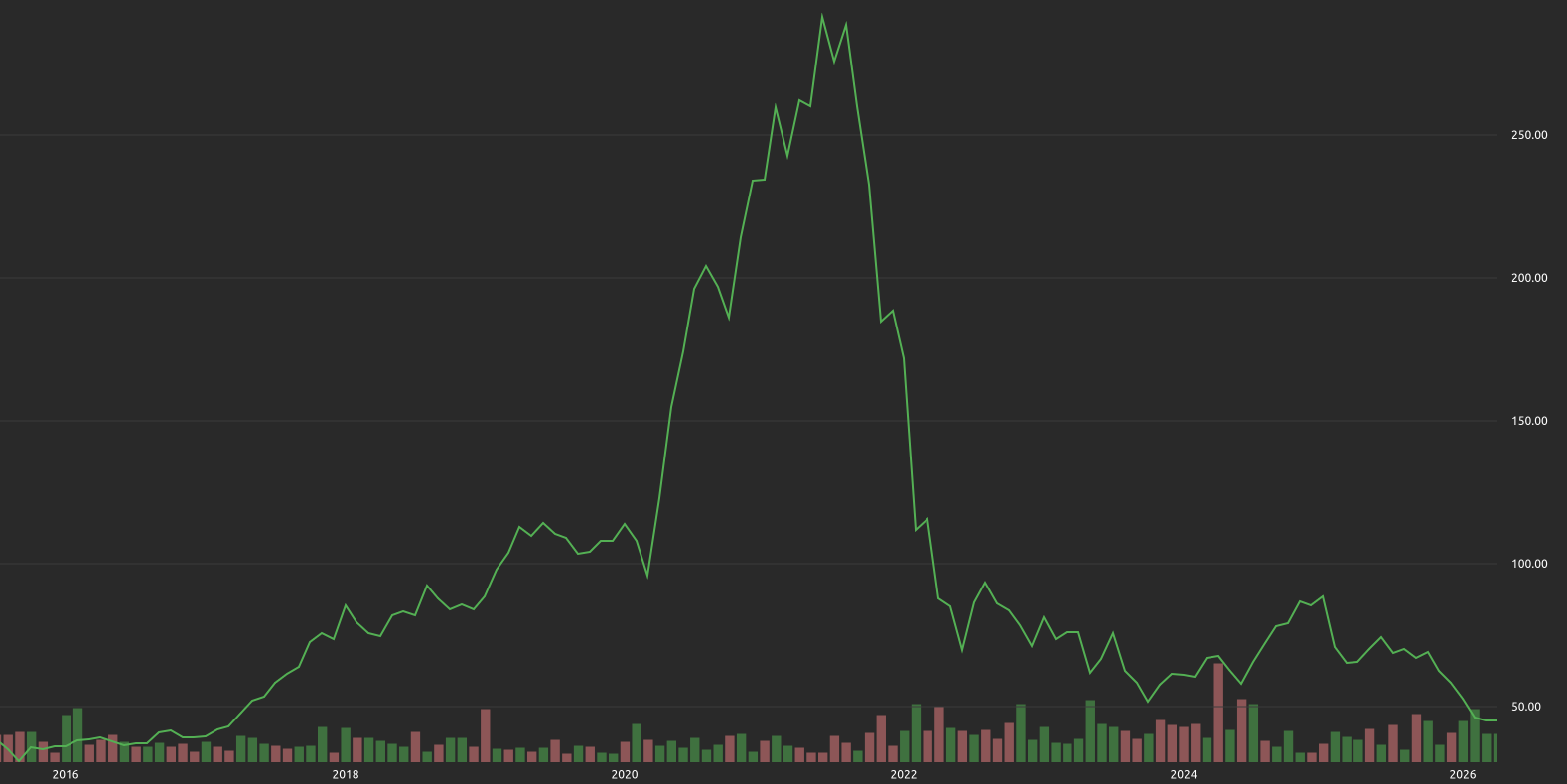
It's fair to say PayPal (PYPL) has been on a tumultuous ride over the last decade. This is reflected in its share price, which rose all the way up to just shy of $300 during the pandemic boom and subsequently fell all the way back down to below $50, where it continues to trade today.
In this article, I'll be exploring the company's fundamentals to try and ascertain whether it's a golden opportunity, or a declining business drawing investors into a value trap.
Business overview
PayPal's core business revolves around its online checkout, which merchants can integrate into their websites to facilitate payments from customers. There are two main versions of this online checkout: a PayPal branded checkout, where a customer either logs into their PayPal account to retrieve their payment and address details or proceeds through a guest checkout hosted by PayPal; and an unbranded "Expanded" checkout, where a user has a range of payment methods from which to choose (including PayPal), but is required to enter their payment and address details (unless stored with the merchant, or they choose PayPal as the payment method).
PayPal charges a transaction fee to the merchant for facilitating the payment, varying by payment method and region, but generally higher for the branded checkout and/or if the customer chooses to pay with their PayPal account. As an illustrative example, the charge stated on PayPal's US website for credit and debit cards is 2.99% + $0.49 for the branded checkout and 2.89% + $0.29 for the unbranded checkout. If the customer uses their PayPal account, the charge rises to 3.49% + $0.49 for both checkout variants.
To illustrate the regional differences, the charge stated on PayPal's UK website for credit and debit cards is 1.2% + £0.20, and for payments using a PayPal account, the fee is 2.9% + £0.30.
One thing to note here, is that these are the advertised charges, likely only applicable to SMEs with relatively low transaction volumes. Larger enterprises will be able to negotiate lower rates, and thus bring the average fee earned by PayPal down. In the company's 4Q25 earnings call, management disclosed the blended take rate across all transactions as 1.65% (it's not stated explicitly, but revenue-neutral peer-to-peer payments may also be included in this blended take rate).
Before moving on to PayPal's other products, I think it's worth dwelling on the current competitive position of the branded and unbranded checkouts. Let's start with the flagship branded checkout.
The key question to ask is: why should a merchant offer its customers the option to pay with PayPal rather than a regular card transaction given the fee differential? The answer is severalfold. First there's a well-documented increase to conversion (claimed to be as high as 62% in a Nielson study commissioned by PayPal) and decrease in cart abandonment when PayPal is available as a payment option. This stems primarily from the fact a customer with a PayPal account doesn't need to enter their card or address details (or trust the merchant to securely save them) in order to make the purchase. Over more than two decades, PayPal has built up a formidable user base, with 439m active accounts across approximately 200 markets as of 31 Dec 2025. Having PayPal as a payment option allows merchants to tap into this user base and make sales they otherwise may not have made.
The second reason is seller protection: when customers pay with PayPal, the seller is protected from fraudulent transactions and chargebacks. If the customer pays through a regular card transaction, the seller is left with the burden of handling these issues, which can become costly.
Something that needs to be addressed head on, is the fact PayPal's branded checkout accounted for more than 50% of the company's profits in FY25. Any hint of a decline in this segment is therefore going to have an outsized impact on investor sentiment, and this is exactly what we've seen as branded checkout TPV growth has started to slow in the last couple of years. There are a number of initiatives underway to try and rejuvenate TPV growth, but their rollout has been slower than anticipated, and the Board fired the CEO earlier this year as a consequence. The Chairman of the Board has taken over the Chief Executive role and has so far said he plans to continue with the current strategy. To paraphrase: "the strategy wasn't the problem; it was the execution".
So let's discuss some of the initiatives, starting with buy now pay later (BNPL). PayPal has offered a Pay in 3 option within its PayPal Checkout since late 2020 in the UK and US markets, and subsequently launched pay-later products in other European markets, including Germany, France, Spain and Italy. In the UK, the merchant pays the same flat 2.9% + £0.30 fee they would for a regular "pay-now" transaction, but in the US, the price was increased to 4.99% + $0.49 (1.5% higher than pay-now). Transaction volumes have grown rapidly, reaching c.$40bn in FY25 and growing more than 20% y-o-y. This gives PayPal significant market share, but still a way behind Klarna, which generated gross merchandise value (GMV) of $128bn globally in 2025.
A key thing to note with PayPal's BNPL business, is that since 2023 it has been offloading its European receivables to KKR, with KKR committing to buy up to €65bn in receivables, providing significant headroom for growth. In the US, Blue Owl Capital has entered into a two-year agreement to purchase approximately $7bn of BNPL receivables originated by PayPal. This capital-light approach removes the credit risk associated with holding the receivables, but equally reduces the margin PayPal is able to earn on each transaction as it will only retain a small fee for originating the loans and collecting the payments.
The attraction of BNPL for consumers is pretty self-evident, but there are also considerable benefits for merchants: well documented evidence shows that it increases both sales conversion and the average order size. This also means it's likely to be a source of TPV growth for PayPal's branded checkout, with one distinct caveat: margins will be lower, particularly where BNPL is offered at the same cost to the merchant as pay-now.
Another initiative is PayPal+, a free reward scheme, where users are able to earn points when making purchases using their PayPal account or a PayPal debit/credit card. They earn 1 point for every £10 spent using their PayPal account or PayPal credit card, and 10 points for every £10 spent using their PayPal debit card. 1000 points are redeemable for £10, so users get the equivalent of 0.1% cashback with their PayPal account or PayPal credit card, and 1% cashback with their PayPal debit card. The debit card deal is obviously the most attractive (though the credit card has its own attractions) and encourages users to load money onto their PayPal account and use their PayPal debit card for everyday purchases.
This in turn should help increase PayPal's TPV, but there are a couple of key things to note: 1) regular card payments made outside a PayPal branded checkout (e.g. in a shop, cafe, or online guest checkout) will earn PayPal a very small fee and certainly less than the 1% cashback it's offering the customer 2) the points can only be redeemed and used in a branded PayPal checkout, and therefore directly increase branded checkout TPV. These two factors offset one another, but the net result is still a reduction in branded checkout profit margin. Global debit TPV grew c.60% to surpass $35bn in FY25, with more than 10m first time debit users.
The third, and most obviously margin destructive, initiative is paying merchants to present the "Pay with PayPal" button more prominently in the list of payment options. When PayPal is at the top of the list, a greater proportion of customers choose to use it, increasing branded checkout TPV but reducing the fees PayPal earns on these transactions.
You can see there's going to be an initial hit to the bottom line from these initiatives to grow branded checkout TPV, and this is reflected in management's guidance for a mid-single digit decline in EPS in FY26.
On the unbranded checkout side, it's a bit more of a mixed bag. PayPal significantly expanded its payment service provider business (referred to as PayPal PSP) when it acquired Braintree for $800m in 2013. At the time, Braintree was the cutting-edge, with a developer-friendly API used by such Silicon Valley darlings as Uber and AirBnB. Today this crown has started to slip. Stripe and Adyen have both entered the field - the former becoming the default for tech startups and SMBs, and the latter gaining substantial market share in enterprise payment service provision. These competitors now have roughly double the total payment volume (TPV) of PayPal PSP and are growing at 30%+ vs PayPal PSP's 8-12%.
With enterprise payments, Adyen has some distinct advantages: banking licenses in the UK, EU and US allowing it to connect to payment rails without intermediaries, reducing costs and speeding up transactions; its own card terminals, which have a large and growing install base, giving it a vertically integrated omni-channel offering; and a focus on enterprise customers, which significantly reduces administrative expenses. This last point is illustrated by the fact Adyen has half as many staff as Stripe, but still manages to process the same payment volume.
PayPal is frustratingly opaque when it comes to disclosing segmental revenue and profit data, so we can't make a direct comparison between PayPal PSP and its competitors. That said, given what we know - the fact PayPal lacks banking licenses; relies on third-parties to provide an enterprise-level omni-channel offering (it does have its own range of card terminals aimed at SMBs, but these are only compatible with PayPal's checkout software); and doesn't focus purely on merchants with large payment volumes - I'd estimate that PayPal PSP generates no more than $150-175m profit on $3-3.5bn of revenue (<5% profit margin) from $600-700bn TPV. To put this in context, the company generated $6.1bn in operating income in FY25. This estimated contribution from PayPal PSP therefore equates to less than 3% of overall operating income.
So far this discussion of PayPal PSP has been somewhat negative, but there are a number of positives to touch on. PayPal has been rolling out a range of add-on products, including the aforementioned seller protections, that have been gaining adoption with merchants. One in particular worth highlighting is the appropriately named Fastlane. Fastlane allows customers using a guest checkout to automatically fill out their payment and address details with a single verification step. This is comparable to Link, offered by Stripe, but PayPal has a distinct advantage with its existing user base, which means customers using an email associated with a PayPal account won't need to fill out their payment and address details again. Increased adoption of these value-add products will be margin accretive, and help to offset the disadvantages PayPal has at the transaction cost level.
One other important business segment I've so far failed to mention is Venmo, a peer-to-peer payments app acquired as part of Braintree. Venmo has attracted a large user base, with over 100m active accounts in FY25 of which 67m are active monthly, but has historically lacked monetisation. This has started to change with the introduction of a Venmo debit card and "Pay with Venmo" option in online checkouts. Venmo's revenue contribution grew c.20% to $1.7bn in FY25 and the revenue mix has shifted towards higher margin revenue streams increasing its profitability.
In addition to the short-term consumer lending we've already discussed, PayPal also lends to merchants through PayPal Working Capital and PayPal Business Loans. The former integrates well into the existing checkout business, as merchants using PayPal's branded checkout are able to borrow a percentage of their historic transaction volume, and repayments are taken as a percentage of future transactions. The latter is just regular business lending, which PayPal has had a mixed record of underwriting, with periods of lower and higher credit losses.
A final business segment to mention is Xoom - an international digital remittance service. PayPal acquired Xoom in 2015 for approximately $890m in cash. The service appears to be popular, with a 4.7/5.0 star rating from 168,152 reviews on Trustpilot, and offers an extensive range of payment options including cash pickup and phone reloading. Given the competition from other companies in the sector such as Wise, Remitly and Western Union, and lack of discussion from PayPal's management, it seems fair to suggest that Xoom only makes a minor contribution to the overall group.
Financials
Moving now to the financials. PayPal generated net revenues of $33,172m in FY25 (FY24: $31,797m), operating income of $6,065m (FY24: $5,325m) and net income of $5,233m (FY24: $4,147m). Earnings per share (EPS) grew more rapidly to reach $5.46 (FY24: $4.03) due to a substantial share repurchase program which we'll discuss in a moment.
On the balance sheet, PayPal had $10,422m in cash and short-term investments at 31 Dec 2025 (FY24: $10,924m), exceeding $9,987m in long-term debt (FY24: $9,879m). It also had $38,198m in funds receivable and customer accounts (FY24: $37,671m), on which it is able to earn interest income. Loans and interest receivables, net of impairment allowances, were $6,746m (FY24: $6,422m), excluding $1,726m of loans and interest receivables held for sale (FY24: $541m). Total equity was $20,256m (FY24: $20,417m), but over half of this is attributable to goodwill on the numerous acquisitions the company has made over the years.
The cash flow statement is where things get interesting. In FY25, PayPal generated $6,416m in net cash from operating activities (FY24: $7,450m), along with $797m in net cash from investing activities (FY24: $1,689m). Adjusted free cash flow was $6,411m (FY24: $6,634m), with the adjustments merely being to remove the effects of timing differences between the origination of credit receivables and their subsequent sale. This free cash flow was used to fund $6,052m in share repurchases (FY24: $6,047m), and starting in Q4, a quarterly dividend amounting to $130m (per quarter).
Valuation and investment outlook
Share price: $46.08
Market capitalisation: $42.43bn
On a trailing basis, the shares currently offer a 12.3% earnings yield, 15.1% free cash flow yield and 14.6% shareholder yield (share repurchases + dividends; annualising the dividend raises the shareholder yield to around 15.5%).
Looking forwards, we already know EPS is expected to decline by a mid-single digit percentage in FY26 as a result of the aforementioned investments. Given the rate of ongoing share repurchases, the decline in aggregate net income will likely be significantly higher (somewhere in the teens).
If management is successful in rejuvenating the branded checkout, and we can look forward to low-to-mid single digit earnings growth in the medium-term, the current share price is almost certainly far too low. Especially when you factor in that the company is able to return virtually all its free cash flow to shareholders, and intends to continue doing so for the foreseeable future. On the other hand, if these turnaround efforts fail and the business begins to steadily decline, the share price probably isn't far off fair value.
Given the asymmetry between an upside of perhaps a 2-3x return within say 5 years and the downside of a roughly market return, mainly fuelled by shareholder distributions, I would rate this a pretty attractive entry point for investors.